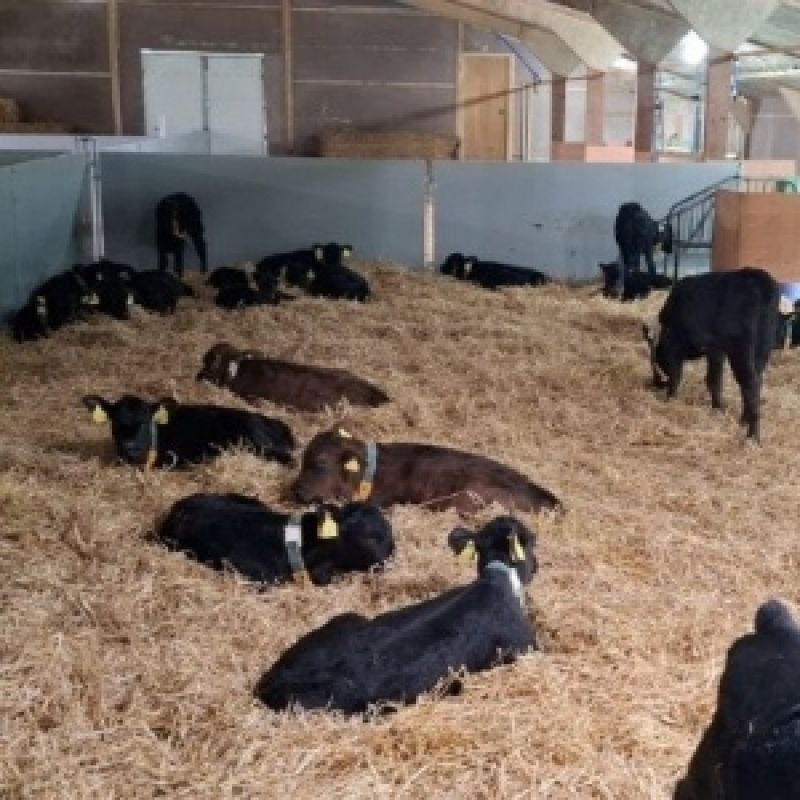
One of the most exciting developments has been preparing a shed for the arrival of our first group of calves, the first livestock we’ve had on the farm since we said goodbye to our free-range hens back in 2011 (ish). It’s a big moment for us and marks the start of a new chapter for Hunmanby Grange.
The cows arrived at the end of February and will stay with us for a couple of months before moving on to lush Yorkshire grassland. Charlie and Paddy have done a fantastic job getting everything ready and ensuring the shed is up to spec. It’s a great step in diversifying the farm and creating another avenue that isn’t solely dependent on selling beer.
Out in the fields, attention has turned to one of the most important periods in our farming calendar, spring drilling.
At Hunmanby Grange Farm, the home of Wold Top, we grow both winter and spring crops. Winter barley and wheat are typically sown shortly after harvest (late September through October), while spring barley and wheat are planted as conditions begin to warm, usually from late February through to early April.
For spring planting, soil temperature is key. We look for it to be around 6°C and rising to ensure strong germination and healthy establishment. Barley produces a fixed number of grains per ear, meaning it can’t compensate for poor establishment later in the season in the same way wheat can. Getting it right from the start is crucial.
If colder, wetter weather is forecast after planting, it’s often better to hold off a little longer to give the crop the best possible chance.
We choose to plant our barley in spring for three main reasons:
1. Flexibility after harvest – We’ve found yield differences between winter and spring barley to be minimal, so spring planting reduces pressure during the busy harvest period.
2. Soil health benefits – It allows us to grow cover crops during the fallow period, helping to improve soil fertility and structure.
3. Sustainable farming practices – Our use of cover crops has enabled us to move to a 100% direct drill/minimum till system across the farm.
2. Soil health benefits – It allows us to grow cover crops during the fallow period, helping to improve soil fertility and structure.
3. Sustainable farming practices – Our use of cover crops has enabled us to move to a 100% direct drill/minimum till system across the farm.
After harvest, we drill cover crops such as phacelia, radishes and black oats. These include nitrogen-fixing and carbon-absorbing plants that improve soil condition over winter. The crop is naturally killed off by frost, and in spring we drill barley directly into it.
This approach means minimal soil disturbance, reduced carbon release, and far less need for traditional ploughing or cultivation.
The benefits of cover crops are well established. They:
• Increase organic matter and improve water retention
• Enhance soil structure and overall health
• Support soil biology, particularly worm activity
• Protect against erosion
• Capture and retain nutrients, reducing leaching
• Increase organic matter and improve water retention
• Enhance soil structure and overall health
• Support soil biology, particularly worm activity
• Protect against erosion
• Capture and retain nutrients, reducing leaching
Our aim, alongside other like-minded farmers and the team at Sustainable Futures, is to strengthen the link from grain to glass – producing sustainable food and drink that doesn’t cost the earth.
Kate and Alex